Case · Go backend
Rooms: realtime chat and board
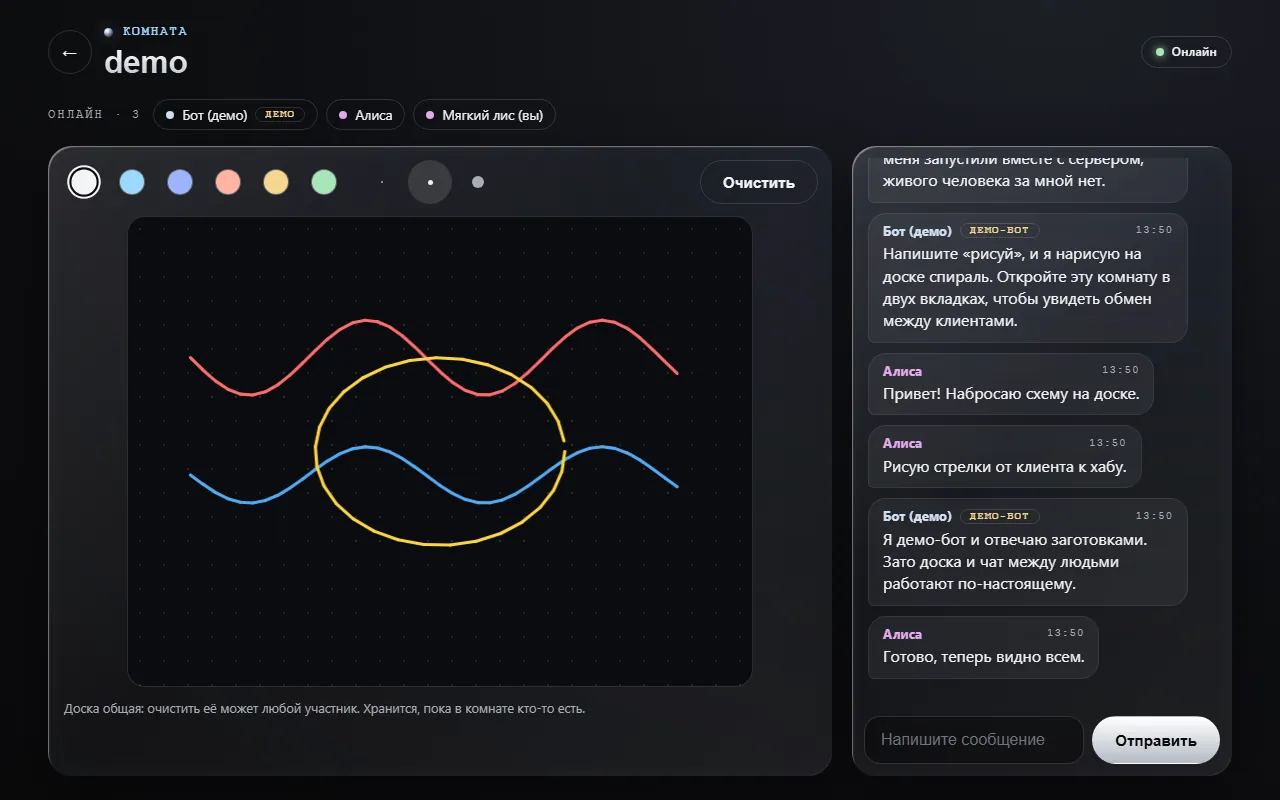
Realtime rooms: chat with SQLite history, an online list, a typing indicator, a shared board with strokes and cursors, anonymous nicknames. WebSocket (RFC 6455) written on the stdlib.
- Go
- WebSocket
- SQLite
- Canvas
- Docker
01 · How it looks
Screenshots
02 · About
What it is and why
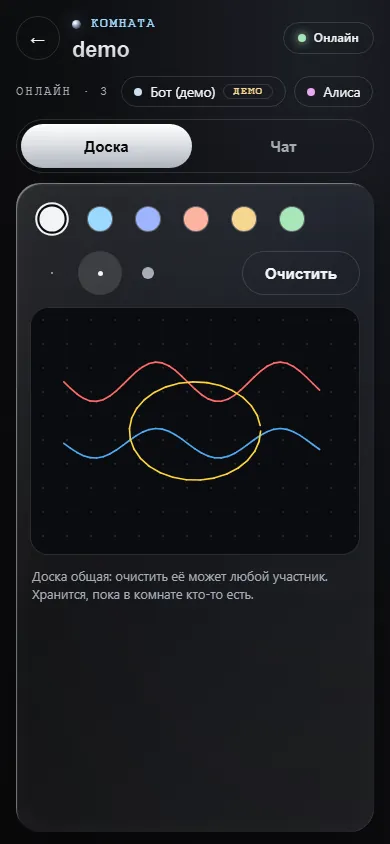
Realtime rooms: a chat with history in SQLite, an online list, a typing indicator and a shared board where every participant's strokes and cursors are visible to everyone at once. No sign-up; nicknames are anonymous.
The WebSocket protocol (RFC 6455) is written on the standard library: handshake, frames, masking, fragmentation, ping/pong and close codes. The only dependency is pure-Go SQLite without CGO; the vanilla JS and Canvas interface is embedded in the binary.
Limitations
A single process with the hub in memory, so there is no horizontal scaling. The board lives in memory and does not survive a server restart (the chat is saved in SQLite).
No TLS or authentication, and nicknames are anonymous and unprotected. There is no permessage-deflate; the Autobahn Test Suite was not run, and correctness is covered by my own tests.
The bot in the demo room answers with canned phrases and is marked as a bot: it is neither a person nor an AI.
What is inside
- Room hub: two goroutines per connection, broadcasting through a bounded queue; a slow client is disconnected and does not hold the others back
- Per-connection rate limits (a token bucket for chat and an overall one); ephemeral messages (cursors, typing) are dropped under load
- Chat history in SQLite: a message is broadcast only after it is saved, the last 50 are sent on join and older ones load page by page
- A shared Canvas board: strokes in normalised coordinates, other people's cursors with nicknames, and the current state is sent to late joiners
- Graceful shutdown: every connection gets close code 1001; the browser reconnects with exponential backoff and jitter
- Protocol and hub tests, a load test with 360 connections in 6 rooms; Docker and GitHub Actions
03 · How to run
Run it locally
git clone <repository on request> realtime-rooms
cd realtime-rooms
SEED_DEMO=1 go run ./cmd/server # http://localhost:8086, room /r/demo04 · Code
The repository is private
The source lives in a private repository. I will grant access on request: write to me and I will send an invitation.
Request the code